Wasm Microservices: A New Operating Model for Enterprise-Scale Agility and Control
Enterprises are hitting the limits of what containers alone can deliver for speed, safety, and portability across cloud and edge. WebAssembly (Wasm) microservices are emerging as a pragmatic next step—packing near-native performance, strong sandboxing, and language-agnostic development into a footprint that boots in milliseconds and runs consistently from data centers to devices. For CIOs, CTOs, and platform leaders, the promise is an operating model that compresses time-to-value, reduces blast radius, and expands deployment optionality without rewriting the entire estate.
Wasm Microservices for Enterprise-Grade Modernization
Wasm began in the browser, but its server and edge trajectory is now unmistakable. With WASI (WebAssembly System Interface), modules can run outside the browser with a capability-based security model that dramatically reduces ambient authority. This matters for regulated environments and multi-tenant platforms where least privilege is not just good hygiene—it is an audit requirement. Compared to containers, Wasm modules start faster, consume fewer resources, and offer tighter isolation, making them well suited for latency-sensitive services, on-demand workloads, request-time plug-ins, and policy-driven extensibility in existing platforms.
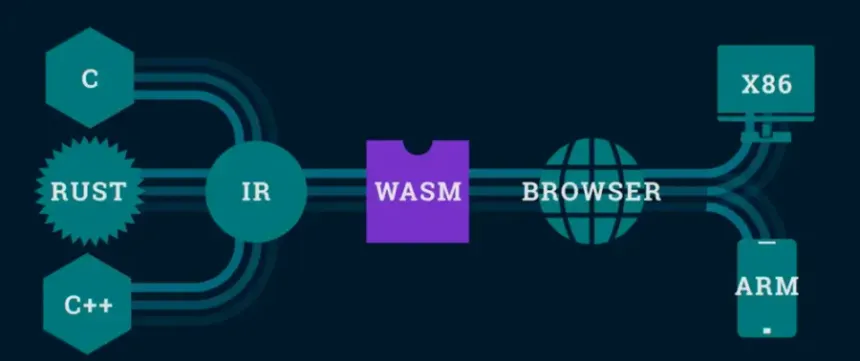
Think of Wasm microservices as small, self-contained compute units compiled from languages like Rust, Go, C/C++, or even higher-level languages via toolchains. They package logic, not an entire operating system image. The result is improved portability across diverse substrates—Kubernetes, serverless frameworks, edge runtimes, and even embedded systems—without the rebuilding gymnastics that typically accompany multi-cloud and edge expansions.
Strategic Context: Why Now
The enterprise pressure profile is clear: expand digital reach, cut unit costs, and harden security while satisfying regulators and customers. Edge growth is real, with data gravity shifting to storefronts, factories, clinics, and mobile environments. Meanwhile, cloud egress, cold starts, and lateral movement risks expose limits in existing models. Wasm microservices offer a disciplined way to consolidate runtimes, deploy closer to the moment of value, and enforce precise capability boundaries.
Equally important is strategic bargaining power. Wasm packages can live as OCI artifacts and run on multiple runtimes (Wasmtime, WasmEdge) and orchestration layers (Kubernetes, Nomad, serverless, or Wasm-native platforms), creating a credible portability story. That reduces vendor lock-in, supports exit strategies, and enables economic arbitrage across clouds and edges. In short: Wasm is a modernization accelerant that aligns with resilient architecture principles and cost-aware operations.
Architecture Blueprint for Wasm-Native Services
Core Components
An enterprise-ready Wasm architecture centers on a few essentials: a trusted module registry with signing (Sigstore cosign), a runtime layer (e.g., Wasmtime or WasmEdge) exposed via Kubernetes, Nomad, or a lightweight edge supervisor; a capability broker using WASI and component model interfaces; a policy layer (OPA/Rego) for authorization and isolation rules; and full-fidelity observability using OpenTelemetry. Secrets should be delivered through short-lived credentials (SPIFFE/SPIRE) with workload identity, not static keys baked into images. Together, these elements combine into a platform that is both secure by default and measurable in production.
Patterns That Work
Lean for sidecar-less designs when possible: Wasm modules can integrate telemetry and policy hooks without heavy per-pod sidecars. Use capability whitelisting to grant explicit filesystem, network, and clock access. Favor message-oriented integration via NATS or Kafka; Wasm modules excel at stateless compute, with state externalized in managed data services. For extensibility in existing apps (APIs, proxies, data pipelines), Wasm is ideal for hot-pluggable filters and request-time logic—think policy enforcement, data redaction, or protocol transformation without restarting the core service.
Integrating With the Existing Estate
Most enterprises will run Wasm alongside containers, not instead of them. Kubernetes remains the control plane of choice; use the containerd wasm shim or Krustlet to schedule Wasm workloads alongside containers. Place a standard API gateway in front (Kong, Envoy), and wire in policy engines and identity providers via established patterns. At the data layer, lean on service brokers and gRPC/HTTP bindings exposed by the Wasm component model rather than direct database drivers. This ensures portability and simplifies compliance audits by reducing the number of privileged access paths.
Operational Model and Tooling
CI/CD for Wasm
Modern pipelines should treat Wasm modules as first-class build artifacts. Compile with reproducible builds, attach SBOMs (SPDX/CycloneDX), sign with cosign, and store in an OCI-compliant registry. Unit and property-based tests must run in the same runtime as production to avoid drift. Incorporate fuzzing—especially for interfaces handling untrusted input—to exploit the smaller attack surface and prevent logic bombs typical in plug-in architectures.
Orchestration Options
Enterprises have three pragmatic paths: augment Kubernetes with Wasm via containerd shims and CRDs; adopt a Wasm-native framework like Fermyon Spin for ultra-fast web APIs and event triggers; or use HashiCorp Nomad with integrated Wasm support for mixed environments. Each enables rolling, canary, and blue/green strategies, but Spin also shines for per-request module instantiation, which is compelling for bursty workloads and policy enforcement at the edge. Regardless of approach, standardize deployment descriptors and promote them through environments using the same promotion rules you use for containers.
Security Engineering
Wasm’s sandboxing is a feature, not a magic shield. Strengthen it with: capability-deny defaults via WASI; zero-trust workload identity (SPIFFE) and short-lived mTLS; SLSA-aligned builds; signed modules and transparent verification at admission; continuous SBOM scanning; and posture assessment integrated with your CSPM/CIEM tools. Remember the principle: fewer capabilities, fewer ways to pivot. For regulated workloads, document the capability grants per module and map them to control frameworks like SOC 2, HIPAA, or ISO 27001 for audit-ready evidence.
Performance and Cost Dynamics
Cold starts for Wasm modules commonly land in the tens of milliseconds, compared to hundreds for many containerized microservices and seconds for some serverless cold starts. Memory footprints are smaller because modules carry no OS baggage. For CPU-bound tasks, Wasm can approach native speeds, and with WASM SIMD, certain analytics or transformation tasks become competitive at the edge. The business translation is straightforward: denser packing on nodes, lower idle cost, and the ability to allocate compute precisely when requests arrive. For high-volume, spiky traffic—checkout flows, personalization, security filtering—this can produce double-digit infrastructure savings while improving tail latency.
What to Measure
Track p95/p99 latencies for cold and warm paths, per-request CPU/memory, module instantiation time, and policy evaluation overhead. Monitor capability grant changes as configuration drift. Tie these to business KPIs: conversion rates under load, SLA adherence in remote sites, and the ratio of spend to peak throughput. Wasm should show measurable gains in these metrics if workloads are well-suited.
Migration Path and Risk Management
Start with candidates that are stateless, compute-heavy, and latency-sensitive: request-time transformations, image/video thumbnails, protocol mediation, fraud checks, and policy engines. Wrap legacy services with Wasm-based adapters to standardize ingress/egress behavior. Use the strangler pattern to gradually carve off endpoints into Wasm modules. Maintain a clean contract via the component model so modules remain portable as runtimes evolve.
Pilot Criteria and Execution
Define a 90-day pilot with a bounded scope, ideally an API or pipeline that experiences volatile demand. Set success metrics: 30–50% cold-start improvement, 20% resource reduction under equivalent load, and zero P1 incidents. Include a security objective: reduce granted capabilities by at least 50% versus containerized equivalents. Run A/B traffic between container and Wasm implementations, capture telemetry via OpenTelemetry, and produce an executive readout that translates technical deltas to financial impact.
Business Outcomes You Can Bank On
Adopting Wasm microservices pays off along three dimensions. First, agility: polyglot development allows teams to choose the best-fit language without fragmenting runtime governance, while near-instant startup accelerates deployment patterns like on-demand scaling and just-in-time plug-ins. Second, efficiency: smaller footprints and faster spin-up lower compute and memory costs, especially valuable at the edge where hardware is dear and remote operations are difficult. Third, risk reduction: the capability model shrinks the blast radius and simplifies compliance narratives, turning audit exercises into evidence-driven, repeatable processes rather than bespoke explanations.
There is also a cultural uptick. Platform engineering teams gain a portable abstraction to unify cloud and edge under one delivery model. Line-of-business teams see faster prototype-to-production cycles. Security teams get guardrails they can interrogate and automate. These outcomes are mutually reinforcing: velocity that stays inside the rails tends to stay in production.
Governance, Compliance, and Data Protection
Wasm’s fine-grained permissions integrate well with enterprise governance. Map permissions like network access, filesystem paths, and environment variables to control requirements in SOC 2 CC6/CC7, HIPAA 164.312 (technical safeguards), and ISO 27001 Annex A controls. Because modules lack ambient OS access, evidence shows up cleanly in audits: a module with no network capability cannot exfiltrate data, and one with no filesystem capability cannot read restricted paths. Pair this with continuous monitoring of capability drift and signed artifact enforcement at admission for strong provenance.
For privacy-sensitive services, move anonymization, tokenization, and redaction into Wasm-based policy filters that run close to data origination. This reduces the need to shuttle raw sensitive data across networks and offers a deterministic enforcement point that is easy to test and certify. Data governance improves not by adding meetings, but by reifying policy into fast, verifiable modules.
Interoperability and Ecosystem Maturity
Fear of ecosystem churn is reasonable. The good news: the Wasm component model stabilizes cross-language interfaces, and OCI registries provide a familiar distribution channel. Major runtimes like Wasmtime and WasmEdge are production-hardened, and Kubernetes integration via containerd shims, Krustlet, and gateway plug-ins is battle-tested. Observability lands through OpenTelemetry; policy via OPA; identity via SPIFFE/SPIRE. In other words, Wasm fits the enterprise toolchain rather than requiring a wholesale replacement.
For platform extensibility, Wasm plug-ins are increasingly favored in service proxies, databases, and data platforms. This gives you a path to standardize extension development across products and teams, creating reusable modules governed by the same signing, testing, and promotion rules. It’s the difference between bespoke scripting and a managed compute fabric.
Forward View: Where This Is Headed
Three developments will push Wasm deeper into the enterprise stack. First, WASI Preview 2 and the component model will make inter-module composition and interface stability robust enough for large-scale programs. Second, integration with serverless and edge providers will mature, turning Wasm into a universal deployment target with consistent economics. Third, AI workloads will adopt Wasm for policy-controlled inference at the edge, enabling privacy-preserving, low-latency model execution with deterministic performance envelopes.
The sooner organizations pilot Wasm microservices, the sooner they will learn where this model shines and where containers still dominate. A dual model will likely persist for years, but those who standardize the Wasm path now will own the migration curve—not be owned by it. By treating Wasm as a strategic operating model rather than a tactical experiment, enterprises can compress innovation cycles, shore up security, and reclaim control over where and how they run the business of software.

Written by
Maxwell Seefeld